Best Books for Sustainable Change
Six books to help you build habits, systems, and routines that survive real life.
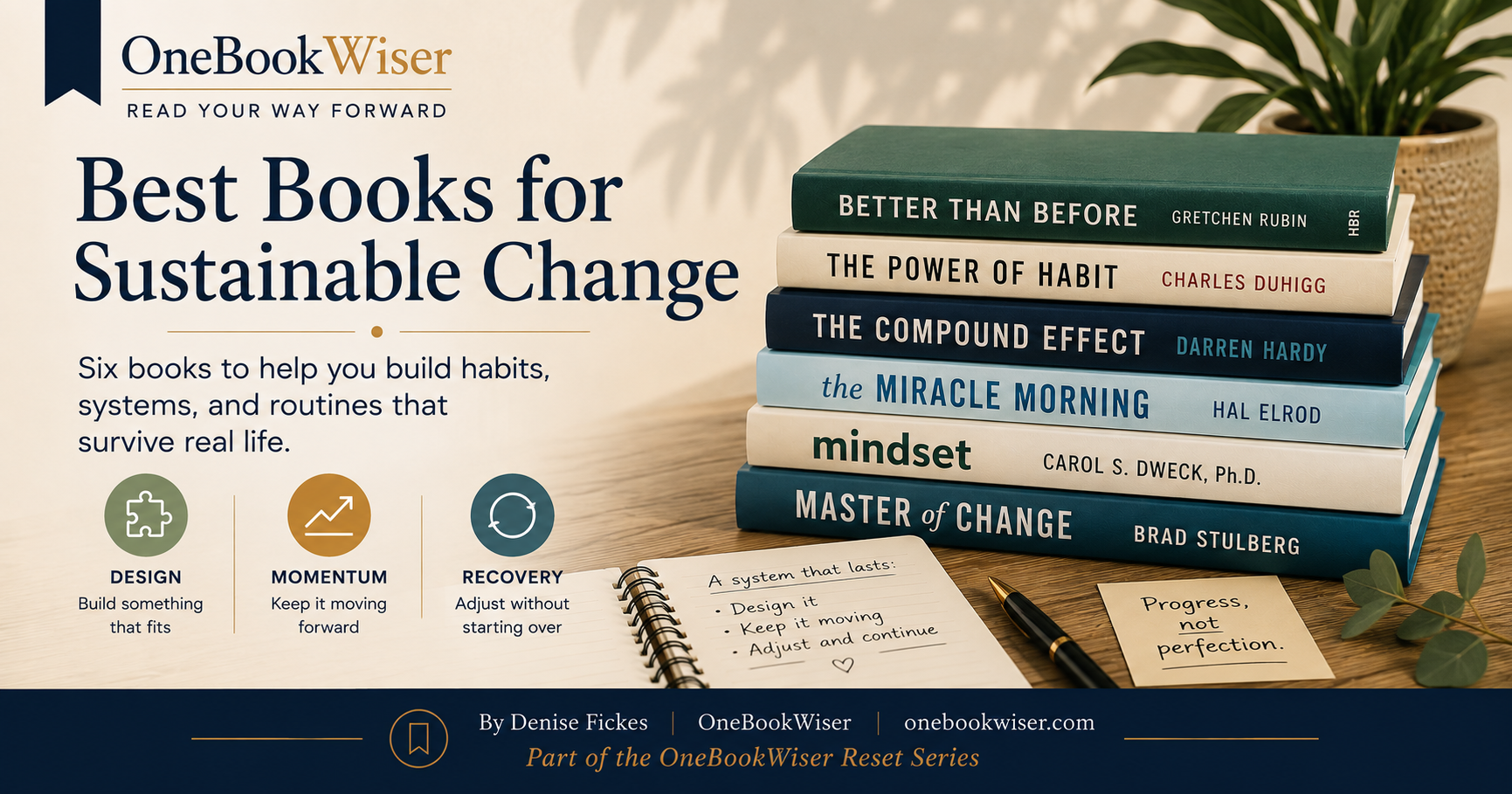
By Denise Fickes | OneBookWiser | onebookwiser.com
Part of the OneBookWiser Reset Series
You made the plan. You started the routine. You meant it this time.
Then life happened. The workout became occasional. The morning routine quietly disappeared. The boundary softened one exception at a time, until it wasn't really a boundary anymore. The system that felt completely manageable three weeks ago somehow stopped working.
So you reset. Again.
The problem may not be that you need another reset. You may need a better system — one built to survive a bad mood, a busy week, a disrupted month — instead of one that only works when everything else in your life happens to cooperate.
That's what this post is about: not another fresh start, but the exercise routine that survives the holidays, the boundary that holds through a lazy summer, a system flexible enough to adjust when life changes instead of collapsing and forcing you back to zero.
Why the Cycle Keeps Repeating
Knowing what you want to change doesn't automatically make it last. Your intentions are usually not the problem — intention and follow-through simply run on different fuel, and most people have plenty of the first without ever developing the second, then can't figure out why they're starting over again so soon.
The usual response is to push harder: more willpower, more discipline, more guilt when it slips. But willpower runs out — not because something's wrong with you, but because it's a limited resource, and no one has an unlimited supply. If more effort hasn't solved it before, more effort probably isn't the real issue.
Sustainable change comes down to three things working together, not one thing done well. Miss any one of them, and you get the familiar pattern: a promising exercise routine that survives October and quietly disappears by December. Here's what all three actually require:
Design — knowing yourself and knowing how habits actually form, so the system you build actually fits how you operate instead of fighting it.
Momentum — the fuel and the ritual that keep the system running once the initial push and excitement are gone.
Recovery — a way to get back on track after a bad day or a missed week, without treating the setback as a sign you've failed.
Here's the part most people miss: when a reset fails, lack of motivation isn't always the problem. More often, something in the system broke down — and figuring out which piece failed tells you exactly where to start.
If the routine always feels unnatural or exhausting — that's a Design problem. Ask yourself: does this system actually fit how I operate, or am I trying to force myself into someone else's method?
If you keep starting but can't maintain it — that's a Momentum problem. Ask yourself: what will keep this going once I no longer feel excited about it?
If one bad week turns into abandoning everything — that's a Recovery problem. Ask yourself: what's my way back in after I inevitably miss a day or a week?
The six books below are matched to these three, and the goal isn't just getting through this reset — it's not having to start from zero the next time life changes.
Design: Build Something That Fits
First understand yourself. Then understand the mechanics of the behavior you're trying to change.
1. Better Than Before — Gretchen Rubin
Best for: Designing a strategy around your actual personality, not someone else's
Rubin's argument is that there's no single right way to build a habit, because people respond to expectations differently — some need outside accountability, some resist it entirely, some need a reason before they'll move at all. A strategy that worked wonders for someone else can fail you for reasons that have nothing to do with effort. This is its own kind of inner work: not knowing what you want, but knowing how you actually operate — what makes you follow through, and what quietly makes you resist. Rubin's Four Tendencies framework helps you find the version built for you.
What you're building: a system designed around how you actually respond to expectations, not a method borrowed from someone whose wiring is different from yours.
Read this when: the change you're after is the right one, but the method you're using to hold onto it never quite fits.
Buy on Amazon | Support Indie Bookshops
2. The Power of Habit — Charles Duhigg
Best for: Understanding how habits actually form, so you can design with the process instead of fighting it
Knowing who you want to become is one thing. Understanding how a habit actually forms — and why the old one keeps winning — is another. Duhigg lays out the cue-routine-reward loop through stories from business, sports, and neuroscience, and once you can see the loop operating in your own life, you stop fighting habits head-on and start working with how they're actually built.
What you're building: the ability to recognize the cue keeping an old behavior alive, so you can redesign the loop instead of white-knuckling through it.
Read this when: you know exactly what you want, but the old pattern keeps showing up anyway, and you want to understand why before you try again.
Buy on Amazon | Support Indie Bookshops
Momentum: Keep It Moving
Consistency gives change time to work. Ritual gives consistency somewhere to live.
3. The Compound Effect — Darren Hardy
Best for: Trusting small, consistent actions when the results aren't visible yet
Hardy makes the case that dramatic transformation almost never comes from one big decision — it comes from small, unglamorous actions repeated so consistently that the math eventually does something that feels impossible. The hard part isn't understanding this. It's staying with a habit through the long, boring stretch before the compounding actually shows up.
What you're building: the patience to trust a process before you can see any evidence that it's working.
Read this when: you're doing everything right, nothing looks different yet, and you're tempted to conclude it isn't working.
Buy on Amazon | Support Indie Bookshops
4. The Miracle Morning — Hal Elrod
Best for: One steady anchor that keeps your momentum going, day after day
The last book gives you the patience to trust a process before you can see it working. This is the other half. Elrod's system is built around six specific practices — but the real insight is simpler than the prescription. One steady anchor early in the day gives everything else something to hold onto, whatever happens after 9 a.m. You don't need his exact six practices. You need your own version of the same idea: a small, non-negotiable ritual that's actually yours, not borrowed wholesale from someone else's morning.
What you're building: not Elrod's six practices necessarily, but the concept behind them — one non-negotiable anchor, designed around what you actually need.
Read this when: you believe the process works, and what's missing is one steady place to actually run it from, every single day.
Buy on Amazon | Support Indie Bookshops
Recovery: Learn to Bend Without Starting Over
First change what a setback means. Then learn how to adapt when disruption hits harder than a setback.
Most systems aren't actually tested on the days they work. They're tested on the day they don't. Design and Momentum get you moving and keep you moving — but sustainable change isn't about never falling off. It's about shortening the distance between falling off and getting back on. A system without a re-entry point isn't really a system; it's a streak waiting to end. What you need instead is a way back in that doesn't require waiting for Monday, next month, or another burst of motivation.
5. Mindset — Carol S. Dweck
Best for: Recovering from a setback without treating it as a verdict
A rough week can undo months of progress — not because of what actually happened, but because of what you decide it means. Dweck's research on fixed versus growth mindset gets at exactly that moment: a growth mindset doesn't require pretending a slip didn't happen, only reading it as information instead of a verdict.
What you're building: the ability to read a bad week as data instead of proof that you were never going to change.
Read this when: you've missed a day, broken a streak, or had the whole week fall apart, and you're deciding what that says about you.
Buy on Amazon | Support Indie Bookshops
6. Master of Change — Brad Stulberg
Best for: Expecting disruption instead of being derailed by it
Mindset changes how you interpret a setback. This book changes what you expect in the first place. Stulberg describes change as moving through a cycle — order, disorder, reorder — where the disorder phase isn't a malfunction, it's the middle of the process. Most people treat the disorder phase as proof the system failed, when it's actually just the part nobody warns you about. His concept of "rugged flexibility" is a repeatable way to move through disruption and back into motion, instead of building a system that only works when nothing goes wrong.
What you're building: a repeatable process for moving through disruption and back into motion, so a bad stretch is something you move through, not something that ends the whole effort.
Read this when: you keep getting knocked off track by things you didn't plan for, and you want a process for getting back to steady instead of just white-knuckling through the chaos.
Buy on Amazon | Support Indie Bookshops
How to Use These Books
You don't need to read all six cover to cover before you start. Use the diagnostic above, then go straight to the book that solves your actual problem:
If your system doesn't fit you → start with Better Than Before.
If an old behavior keeps taking over → start with The Power of Habit.
If you're losing patience because results are slow → start with The Compound Effect.
If you need a consistent anchor → start with The Miracle Morning.
If setbacks make you quit → start with Mindset.
If disruption keeps derailing you entirely → start with Master of Change.
Come back to the others once that piece is solid. Design, Momentum, and Recovery build on each other, but they don't have to happen in order. Eventually, though, sustainable change needs all three.
Don't read all six because they're on this list. Read the one that solves the problem you actually have.
The Reset Series
A real reset happens in three moves.
THE RESET SERIES
RESTORE → Best Books for the Fall Reset Get yourself functioning again.
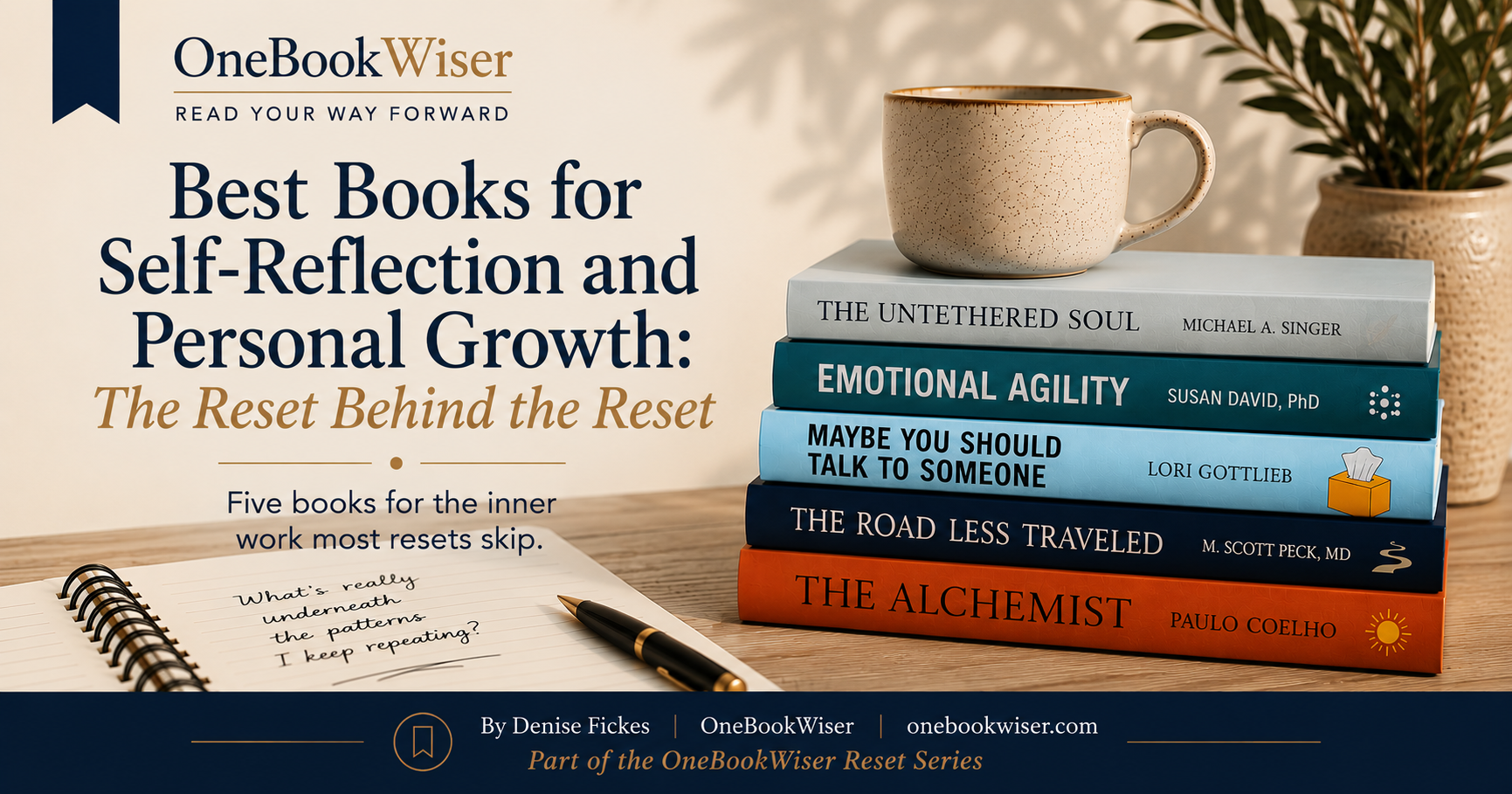
REFLECT → Best Books for Self-Reflection and Personal Growth Figure out what actually matters now.
REBUILD → Best Books for Sustainable Change (this post) Build systems that survive real life.
This post is Rebuild, the third move, but you don't need to have made the other two to get something out of it. If Restore or Reflect is where you actually are right now, start there instead.
The Takeaway
Clearing space and finding clarity get a reset moving. They were never going to be what kept it going.
What keeps it going is less exciting: a system built around how you actually operate instead of borrowed from someone else's routine, momentum sturdy enough to survive the excitement wearing off, and the ability to treat a bad week as data instead of a verdict on who you are.
Build those three, and something shifts. The exercise routine survives the holidays. The boundary holds through the lazy days of summer. Circumstances will still change — priorities shift, life throws things at you — and you'll still need to adjust sometimes.
The goal was never to build a life that doesn't change. It's to build one flexible enough to change with you — so the next time life shifts, you adjust instead of starting over.
Disclosure: Links above may be affiliate links. If you purchase through them, we may earn a small commission at no extra cost to you. This helps keep OneBookWiser free. We only recommend titles we genuinely believe in.
Looking for your own personalized starting point? Take the free 5-question quiz at OneBookWiser and get three book or podcast recommendations matched to exactly where you are right now.
About Denise
Denise Fickes has spent more than two decades leading finance organizations through acquisitions, ERP implementations, restructurings, operational transformation, and periods of rapid growth. She founded OneBookWiser because she believes the right book, at the right moment, often changes how you think faster than anything else can.