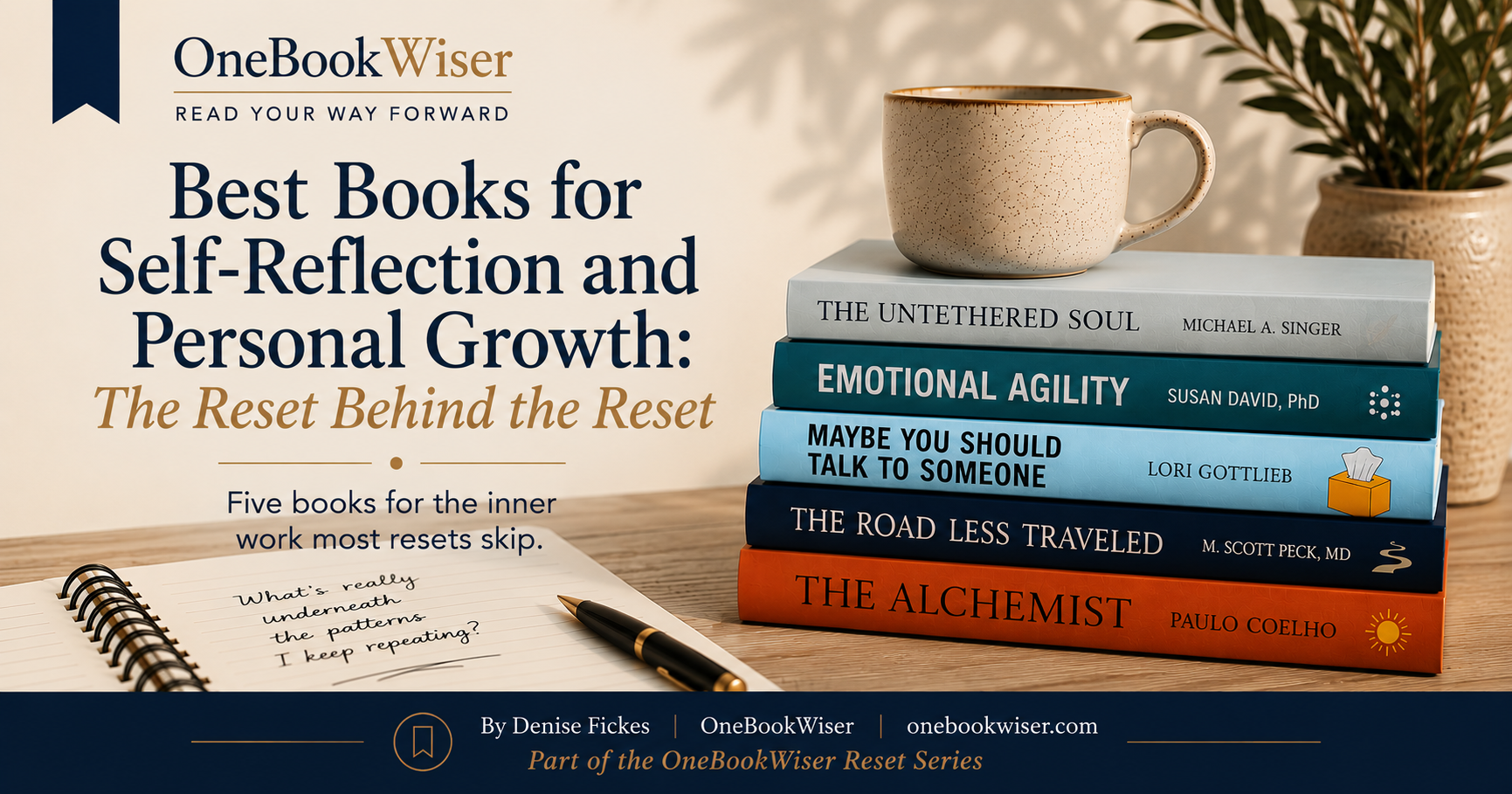
Best Books for Self-Reflection and Personal Growth: The Reset Behind the Reset
Five books for the inner work most resets skip.
By Denise Fickes | OneBookWiser | onebookwiser.com
Part of the OneBookWiser Reset Series
Say you've decided to start waking up earlier and exercising before work. It made the list because you know what it does for you — clearer thinking, better mood, more patience by the time the day gets hard. The plan is simple. You've done it before. And still, morning after morning, the alarm goes off and you don't move.
It's tempting to call that a discipline problem. But the same stalled routine can be pointing at very different things underneath it, depending on the person:
Avoiding the exercise because it's really the day itself you don't want to face
A routine that got tangled up with guilt or "should" somewhere along the way, so your body resists the tone of it
The only quiet no in a day full of obligations to everyone else
Movement leaves you alone with your thoughts, and some part of you would rather not be
No real "why" behind it — nothing that can out-argue the snooze button on a hard morning
Same missed alarm. Five different reasons it might keep happening. That's the layer most resets never touch — and it's the layer this post is about. Why something as simple as waking up and exercising might be more complicated than a lack of discipline.
A few years back, during a stretch of poor sleep and mounting pressure, I snapped at a teammate in a meeting over something that wouldn't normally rattle me. I apologized on the spot. But the moment stayed with me — proof of how thin the margin gets when life is pressing in, no matter how put-together things look on the outside.
I snapped because in that moment, I knew that if she didn't listen, we'd be going over the same thing again that night — time pulled away from other pressing work, work I worried I wouldn't finish, work that might make me look bad if I didn't. Underneath the irritation was something quieter I didn't want to admit out loud: a fear that I wasn't good enough. That fear had crept into a meeting that had nothing to do with it.
That's what eventually changed how I thought about growth. I stopped asking, "How do I become more disciplined?" and started asking, "What's actually underneath this?"
These aren't abstract ideas to me. Every capability below came from a mistake, a hard season, or a decision that reshaped my career or my life outside of it.
The Challenge
This is the second post in the Reset Series. If you read The Fall Reset first, you already have a plan for the outer layer — better sleep, tighter focus, small daily habits that add up. If you're joining here, the short version: the Fall Reset rebuilds the routines and boundaries that carry you through a demanding season.
But that layer only holds if what's underneath it holds too. You can set every boundary you know how to set and still feel like you're managing the same exhaustion, the same self-doubt, the same patterns dressed up in a new routine.
The reset most people skip isn't behavioral — it's the relationship you have with your own thoughts, emotions, and story, and it quietly decides how well the visible changes hold. Take that moment I mentioned above: I'd been keeping better boundaries and sleeping more that month than I had in a while. None of that mattered to the teammate on the receiving end of my sharp tone — they just felt the sting of it. The habits were real. They weren't enough on their own.
The Hard Truth
We're trained to fix what's visible — a missed deadline, a cluttered inbox, a lapsed gym habit. Easy to name, easy to solve with a system. The deeper drivers — the emotions we avoid, the identity we're attached to, the patterns we can't see because we're standing inside them — don't respond to systems. They respond only to awareness.
I want to be honest: this work doesn't wrap up in a season, or even a year. I've been at it for decades and still catch myself falling short. The difference isn't mastery — it's noticing faster, and owning it quicker. A new habit fits neatly into a morning routine. Sitting with a hard feeling long enough to understand it doesn't fit anywhere — it happens at inconvenient times, on its own schedule, not yours.
The Inner Reset
A reset that actually holds asks you to build five inner capabilities. Each one shapes how you show up with other people just as much as how you feel on your own — the same way the missed alarm at the start of this post was never really about discipline.
The stories that follow happen to come from my career, but the underlying patterns aren't about work. They show up wherever people are trying to grow — in relationships, at home, and in the way we respond to ourselves when life gets hard.
Inner freedom — the ability to separate who you are from the thoughts and emotions passing through you. I learned this the hard way once when a colleague bluntly told me I might not be doing my job as well as I should be. I was insulted in the moment — until I stepped back and realized his frustration was with a hard situation, not with me. That half-step of separation is what let me actually hear him instead of just defend myself.
Emotional agility — working with difficult feelings instead of suppressing them or being ruled by them. I still think about the time I was passed over for a promotion that went to someone who, by any honest measure, wasn't qualified for most of the role. I held it together in the meeting. What took real time was afterward — sitting with that feeling long enough to actually process it, while still showing up effective every day in the meantime. That's the difference between suppressing a feeling and working through it: only one of them lets you show up the same way again tomorrow.
Self-insight — seeing your own patterns clearly, often only after someone else names them for you. Earlier in my career, a colleague told me plainly that my perfectionism was stressing out my team, and that I'd be more effective focused on two or three things at a time instead of all of them. I was defensive at first. Years later, I recognized that same instinct in an employee whose missed deadlines had nothing to do with a lack of reminders or checklists — it was his own perfectionism, the same pattern my colleague had once named in me.
Honest discipline — the willingness to sit with hard truths instead of managing around them. For years I thought my stress came from having too much to do. It took a long time to admit that some of it came from saying yes when I wanted to say no. The workload wasn't the whole problem. My inability to disappoint people was. Once I could admit that, "no" stopped feeling like a failure and started being the discipline itself.
A sense of direction — trusting the pull toward what matters, even when the path isn't obvious. Early in my career, I left a senior manager role at a top public accounting firm — one of the most prestigious in the industry — for my first job in a regular company. It was a real step down in title and pay that made no sense on paper. Something told me it was right, and it was: that decision became the biggest springboard of my career. It taught me that the moves that don't make sense on paper are sometimes the ones your gut can see most clearly.
I didn't figure any of this out on my own. Some of it came from questions I spent years avoiding, some from close friends willing to tell me the truth, and some from finding the right book at the right moment — which is exactly what this next list is for.
The Books
Five books, each matched to one of the capabilities above. I'd recommend reading them in this order, though your own reset may call for a different path.
1. The Untethered Soul — Michael A. Singer
Capability: Inner freedom
Singer's central idea is deceptively simple: you're not your thoughts or your emotions — you're the awareness behind them. Once that distinction clicks, a lot of what feels like a personality flaw starts to look like noise you no longer have to obey.
✦ The reset only holds if you can separate the noise in your head from who you actually are — this book teaches you how, before anything else.
When to read it: Start here. This book resets the lens you'll use for everything that follows.
Best for: Separating yourself from your thoughts
Buy on Amazon · Bookshop.org
2. Emotional Agility — Susan David
Capability: Emotional agility
Harvard psychologist Susan David makes the case that the goal isn't to feel better — it's to get better at feeling, so emotions inform your decisions instead of hijacking them.
✦ Feeling something difficult without letting it run the show isn't a personality trait — it's a skill, and David shows you exactly how to build it.
When to read it: Read this once you've absorbed The Untethered Soul. It turns the awareness you just built into a practical, everyday skill.
Best for: Emotional flexibility
Buy on Amazon · Bookshop.org
3. Maybe You Should Talk to Someone — Lori Gottlieb
Capability: Self-insight
Therapist and patient at once, Gottlieb writes with rare honesty about what it looks like to face your own blind spots. It reads like a novel, but it teaches like a mirror.
✦ The patterns holding you back are hardest to see because you're standing inside them — Gottlieb makes them visible without making you feel exposed.
When to read it: Read this in the middle of the reset, when you're ready to look at your own patterns instead of just managing your reactions to them.
Best for: Understanding your patterns
Buy on Amazon · Bookshop.org
4. The Road Less Traveled — M. Scott Peck
Capability: Honest discipline
Peck opens with four words that set the tone for the entire book: life is difficult. From there, he builds a case for discipline, delayed gratification, and facing reality directly — the parts of growth no habit tracker can shortcut.
✦ Real discipline starts with admitting life is difficult, not managing around that fact — Peck's honesty makes room for your own.
When to read it: Read this when you're ready to stop managing symptoms and start doing the harder, quieter work underneath them.
Best for: Deep self-understanding
Buy on Amazon · Bookshop.org
5. The Alchemist — Paulo Coelho
Capability: A sense of direction
Coelho's parable about a shepherd chasing a recurring dream isn't really about treasure. It's about following that pull toward what matters, even when logic can't fully explain it.
✦ After the hard inner work, this story gives you permission to trust the pull toward what matters — even when it doesn't fully make sense yet.
When to read it: Save this for last. It's the exhale after the excavation — the book that sends you back into your life with direction instead of just insight.
Best for: Spiritual direction
Buy on Amazon · Bookshop.org
The Takeaway
The outer reset gets the attention because it's visible — the new routine, the boundary you finally set. But the reset that actually lasts happens somewhere no one else can see: in how you relate to your own mind. Do that work first, or at least alongside the visible changes, and the outer changes stop being something you have to force. They become the natural result of who you've already become.
That fear I mentioned at the start — the one that had nothing to do with the meeting it showed up in — never fully goes away. What changes is how much room you give it to drive.
I've spent a good part of my career coaching and mentoring people through exactly this kind of underlying work, and I can tell you it's a frustrating journey to take alone. If you're finding yourself stuck, find a therapist, a mentor, a trusted friend — someone to think out loud with. You don't have to figure this out in isolation.
And above all, be compassionate — with yourself, and with the people around you. This work moves at a different pace for everyone. Most people are operating with good intentions, even when it doesn't look that way from the outside. That's worth remembering about them, and it's worth remembering about yourself, too.
About Denise: Denise Fickes has spent more than two decades leading finance organizations through acquisitions, ERP implementations, restructurings, operational transformation, and periods of rapid growth. She founded OneBookWiser because she believes the right book, at the right moment, can change how a leader leads — and how a person sees themselves outside of work, too.